 RZST
RZSTRZST: Domain-Agnostic Multi-Agent Orchestration
“We propose a system where multiple computer programs work together like a good team of ranch dogs to sort out tough problems.”
A simulated blueprint engineered to become the answer to solving the world’s most complex distributed data bottlenecks.
The RZST Engine: Stateful Orchestration & Governed Autonomy
Strip away the poetry and the hype. The RZST “Engine” is just complex math, lots of data routing, and systems engineering. Capable of finding theoretical blueprints to fix very real problems.
“The computers are engineered to do the heavy lifting, but a real human keeps a hand on the reins so the machine doesn’t spook and run off.”
RZST operates as an agile orchestration layer utilizing advanced, stateful multi-agent frameworks to model complex, long-horizon workflows, reducing human bottlenecks.
However, unconstrained AI suffers from trajectory drift and hallucination. To bridge the gap between generative artificial intelligence and future physical execution, our architecture enforces “Governed Autonomy”.
We propose rigorous Human-in-the-Loop (HITL) checkpoints and utilize processes mirroring Directed Acyclic Graph (DAG) logic to ensure that our simulated autonomous agents operate strictly within defined mathematical, ethical, and physical constraints.
Infinite Scalability: Beyond the Biological Substrate
While the RZST system proposes immediate flagship deployments focusing on synthesizing high-fidelity digital twins for clinical trials, the RZST multi-agent architecture is inherently domain-agnostic. Any industry reliant on multi-scale modeling, decentralized physical execution, or complex causal inference can integrate our orchestration frameworks.
From optimizing Decentralization of data to orchestrating automated, distributed results—and extending further into energy systems, climate remediation, and planetary-scale infrastructure—RZST’s Domain-Agnostic Multi-Agent system provides the computational scaffolding for the next era of governed, automated innovation.
AI Methods Producer
Beyond the Prompt
What Is an AI Methods Producer? Generative AI has moved from a novelty to a complex production‑grade tool. That gap between a single ai-agent’s output and a global unified data pipeline is where this role comes in.
Using an AI tool to make a single image is very different from running a global marketing campaign that generates thousands of on‑brand assets a day. This analogy is where the AI Methods Producer comes in.
This emerging role is one of the most critical in modern AI (llm) operations. An AI Methods Producer doesn’t just use AI—they build the methodologies, workflows, and infrastructure that let teams harness AI reliably, at scale, and with consistent quality.
In short: they are the architects of AI‑powered production.
The Role
What Does an AI Methods Producer Actually Do?
At its core, the role is a hybrid of creative producer, technical program manager, and systems architect. An AI Methods Producer designs the production engine—the repeatable process that turns a creative brief into finalized products using a combination of AI tools, autonomous agents, and human oversight.
“Think of the AI Methods Producer as a digital Ranch Foreman. They aren’t just ridin’ the AI; they’re buildin’ the whole ranch so the work gets done right, every single time, without the cattle wanderin’ off into the scrub.”
- Design Multi‑Stage Workflows: They map out every step of production: from initial concept to final delivery. This includes deciding which AI tools are used, how they connect, and where human intervention is required.
“The AI Methods Producer isn’t the one peelin’ the potatoes or flippin’ the steaks. They’re the one who designed the kitchen, decided which stoves to buy, and made sure the woodpile is high enough so the whole crew gets fed on time without the kitchen burnin’ down.”
- Select & Integrate Tools: With dozens of AI tools available (LLMs, image generators, video synthesis, voice cloning), the producer evaluates, tests, and integrates the right ones into a unified pipeline.
- Build Agent‑Based Systems: They often deploy “agents”—autonomous software routines that manage prompts, validate outputs, route assets, and handle exceptions—to make workflows scalable.
“These ‘Agents’ are like the cow‑dogs of the digital world. They handle the grunt work—herdin’ data, checkin’ for errors, and keepin’ the ‘AIs’ in line—so the human in charge can focus on the horizon instead of chasin’ every stray calf.”
- Establish Quality & Governance: AI Methods Producers create prompt libraries, style guides, and QA checklists to ensure outputs meet brand standards. They also work with legal and brand teams to enforce responsible AI usage.
“Think of these ‘Agents’ like a series of automated gates in a corral. Instead of a man standin’ there swingin’ a gate shut, the system knows when a ‘steer’ (or a piece of data) is the right weight and color, and it clicks shut or opens up all by itself to keep the herd movin’ the right way.”
- Optimize & Scale: Once a workflow is built, they measure performance (speed, cost, quality) and iterate to improve efficiency. They also train creative teams to work within the new system.
The Process
From Chaos to Orchestration
The complexity of AI‑powered production is often underestimated. For example in the multimedia industry: A single deliverable—say, a 30‑second personalized video ad—may require:
- A large language model to generate script variants
- A text‑to‑image model to create backgrounds
- A voice synthesis AI for narration
- A video generation tool to combine elements
- A final rendering agent to apply branding
Each tool has its own interface, prompt style, and output quirks. Without a structured process, the result is chaos: inconsistent quality, wasted time, and an inability to scale.
“A messy AI process is like a gate left open during a dust storm. The AI Methods Producer builds the ‘chutes and pens’—a structured workflow where ideas go in raw and come out branded, polished, and ready for market.”
“An AI model is like a deep well. It’s got plenty of water down there, but it don’t do you no good unless you got the right pump, the right pipes, and a producer who knows how to turn the faucet so it don’t flood the garden or come out muddy.”
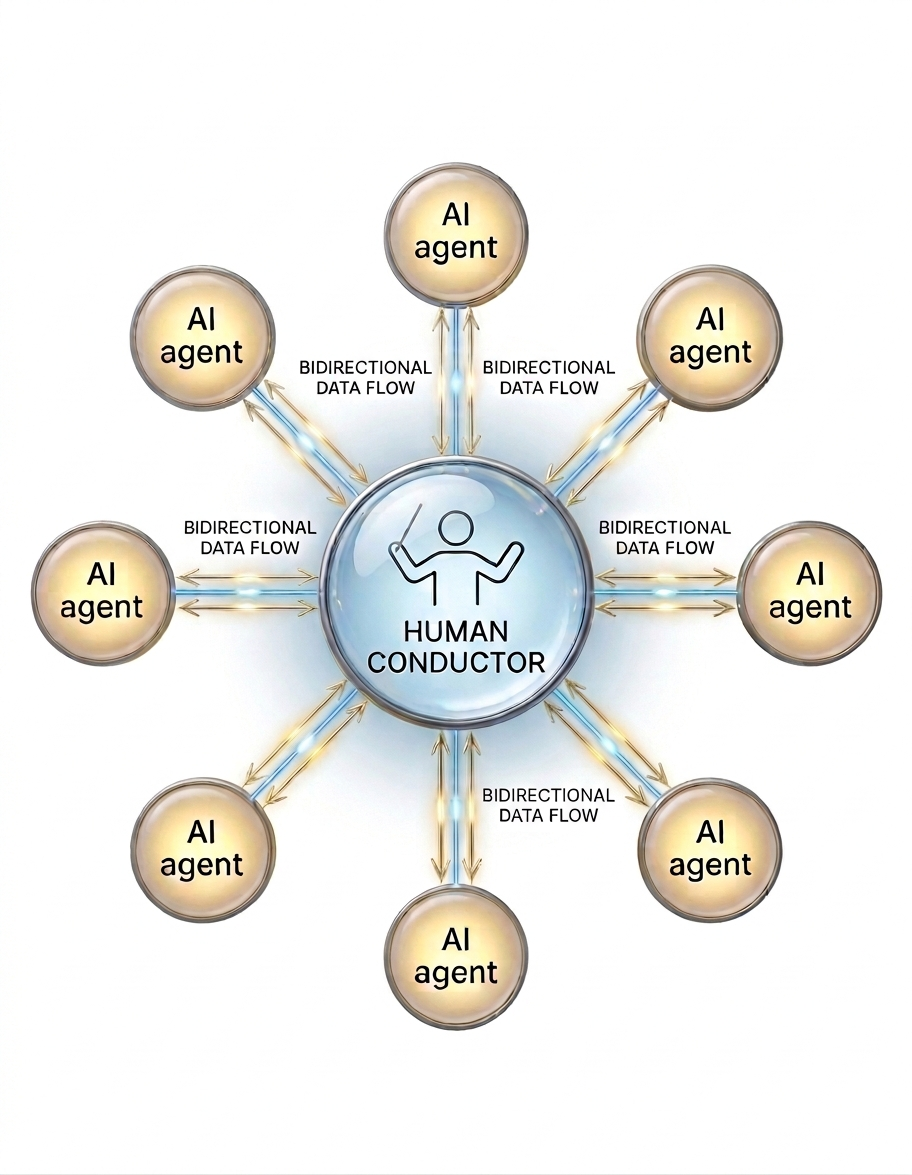
This is where the AI Methods Producer’s architecture comes in. The diagram below shows how they structure these elements into a controlled, repeatable machine.
Architecture
Breaking Down the Architecture
AI Nodes
Each “AI” in the diagram represents a specific model or service—a generative image model, a video synthesis tool, or an LLM. The producer selects and configures each one.
Agents as Controllers
Agents sit between the human and the AIs. They format prompts, validate outputs for brand compliance, retry failed generations, and pass data to the next step.
Bidirectional Data Flow
Command‑and‑feedback loops. An agent sends a prompt to an AI and receives results; the human conductor can intervene at these points to approve or refine.
The Human Conductor
Not a passive supervisor. The human conductor sets creative direction, makes high‑level decisions, and steps in when the automated system encounters ambiguity—without being bogged down in repetitive tasks.
Strategic Value
Why This Role Is Critical for The Future
AI Methods Producers bridge a gap that traditional roles can’t cover. Without this role, companies often fall into one of two traps:
- Ad‑hoc use: Individual creatives experiment with AI, but outputs are inconsistent and can’t be scaled.
- Over‑automation: Teams try to replace humans entirely, leading to quality issues and brand risk.
The AI Methods Producer builds a human‑in‑the‑loop system that balances automation with creative control—exactly what the diagram’s “Human Conductor” represents.
“Automation without oversight is a runaway stagecoach. The AI Methods Producer ensures there’s always a hand on the reins, guidin’ the machine’s power with human intuition and common sense.”
“The AI system is the herd, and the agents are the cow dogs. But even the best dogs need a Trail Boss on a horse lookin’ at the horizon, seein’ the storm clouds comin’, and decidin’ if the herd needs to turn left or right. The machine can run, but only the human knows where we’re actually tryin’ to go.”
Qualifications
The Skills That Make an AI Methods Producer
This isn’t an entry‑level job. Most AI Methods Producers come from a background in creative production, marketing operations, or technical program management, and have added deep generative‑AI expertise.
| Skill Domain | Description |
|---|---|
| Production Experience | Excels at managing creative workflows (video, motion, design) |
| Generative AI Mastery | Expert‑level skills in software programming languages, the use of AI tools from code generators to other domains such as RunwayML, Adobe Firefly, and LLMs |
| Workflow Engineering | Ability to design, document, and optimize multi‑step processes |
| Cross‑Functional Collaboration | Working with creative, legal, IT, and brand teams |
| Tool Integration | Experience with APIs, automation platforms (e.g., Zapier, Make), and prompt engineering at scale |
The Future
AI Methods Producer as a Standard Role
As generative AI becomes embedded in every stage of content creation, the AI Methods Producer will become as common as a creative director or senior producer. Companies that invest in this role now will be the ones that can scale personalization, reduce production costs, and maintain brand integrity in an AI‑driven world.
For creative professionals, it represents a new career path—one that combines creative vision with systems thinking and technological fluency.
A personal note
The Collaborative Orchestrator
Engineering a Future Worth Inheriting
A transparent account of the genesis, mission, and open invitation behind the RZST engine.
Section I
The Genesis of Synthesis
The RZST platform was not born in a multi-million-dollar laboratory— It was forged and driven by the meticulous curation of publicly available knowledge and the urgent necessity of creating a holistic future. In this quest we realized that humanity does not necessarily need to invent new foundational mathematics to solve our greatest systemic crises. The tools already exist.
The crisis is one of orchestration, and the courage to computationally act before the window of recovery closes on us.
The RZST engine was built to act as a supreme computational synthesizer—a framework designed to simulate and logically stitch together disparate, siloed breakthroughs into viable, testable blueprints. It is an act of Digital Resilience: taking the “tools at hand” to build a bridge where centralized systems struggle to expand.
Section II
The Medical Crucible: Our First Stress Test
To prove that our domain-agnostic engine could architect a mathematically sound revolution, we proposed our first in-silico blueprint against the $2.6 billion neurodegenerative drug development pipeline. This is the very bottleneck that leaves families waiting in a referral limbo while the clocks of their loved ones run down.
The resulting flagship blueprint proposed a synthesis of two foundational methodologies:
- The D-CLEF Architecture (pioneered by Kuo et al., 2025): To decentralize the network topology.
In plain English: We propose an architecture that lets hospitals keep their own private patient records locked up safe, and we just share the math between them. - The FedECA Framework (Owkin / du Terrail et al., 2025): To apply causal inference mathematics and statistically balance Virtual Control Arms.
In plain English: Our simulated pipeline uses math to simulate a control group so sick folks aren’t proposed to get stuck taking sugar pills when they need real medicine.
By computationally mapping a path through this complex bottleneck, we validated our core premise: the orchestration logic works because it is designed to be fueled by the clinical imperatives of the patient, prioritizing human life over systemic delays.
Section III
Universal Systems Architecture
Behind the scenes, the domain-agnostic engine is currently being evaluated in viability by simulating blueprints for macro-ecological restoration and optimized resource allocation. We treat the micro-biology of a neuron and the macro-ecology of a continent with the same rigorous mathematical baseline. We recognize that the biological health of our aging populations and the sustainability of our global environments suffer from the exact same centralized data bottlenecks.
This is the logic of a weaver acting as a systems architect: the understanding that all systems are interconnected and that a failure in the “micro” is mirrored in the “macro.”
We are engineering a framework capable of mapping fractured knowledge silos with artificial intelligence to any failing centralized system that has lost sight of the human life at its center. RZST represents the power to generate the solutions of the future.
Section IV
An Invitation to Collaborate
This is not just a call for data; it is a vow of service. We have mapped the theoretical architecture, but an in-silico simulation cannot exist in a vacuum. The next phase of the RZST platform is open collaboration.
Everything we have built is an in-silico computational blueprint. We are providing the foundational architecture. If you believe that decentralized mathematics can structurally replace stagnation and restore the dignity and equity of the individual, the mission begins now. Join us in optimizing the engine for the sake of the generations to follow.
We are actively seeking computational biologists, biostatisticians, DeSci developers, and systems architects to rigorously stress-test our engine. We invite the global scientific community to peer-review our synthesized pipelines, challenge our causal inference models, and help expand the engine’s parameters into new domains.
The Architectural Blueprint is Ready.
Whether you are an enterprise seeking privacy-preserving data interoperability, a principal investigator requiring computational validation, or an organization ready to apply the next generation of AI Methods Production to your agents—integrate with the architecture.
Or reach us directly at contact@rzst.org